
Why won't a contractor give me a price per square foot over the phone?
Because the square footage is only part of the job. A fair quote has to account for demolition, haul-away, grading, base material, forms, reinforcement, the pour, the finish, joints, cleanup and the permit. Most of those depend on conditions that are only visible on site.
A quick phone number tends to be either padded to cover surprises or too low and followed by change orders. A site visit and a written, itemized quote protect you from both.
What makes a concrete driveway cost more or less?
The table below shows the main cost drivers and what typically moves each one.
| Cost factor | Pushes the cost up | Keeps the cost down |
|---|---|---|
| Size and shape | Large areas, curves, a circular drive, extra parking pads | A simple rectangle |
| Demolition | Thick old concrete, asphalt with a base, buried debris | Bare ground or lawn |
| Access | Tight side yards, no room for equipment or a truck | Open front access |
| Base and grading | Soft or organic soil, low spots, fill needed | Firm, well-drained ground |
| Drainage | Water that runs toward the house, standing water, added drains | Natural slope toward the street |
| Reinforcement and thickness | Heavy vehicles, boats or RVs | Normal passenger cars |
| Finish | Stamped patterns, integral color, exposed aggregate | Standard broom finish |
| Permits and approvals | Architectural review, work in the public swale, HOA approval | A straightforward residential permit |
Which concrete finish should I choose?
Choose by how you use the driveway and how much upkeep you want, not only by looks.
| Finish | Look | Traction when wet | Upkeep |
|---|---|---|---|
| Broom finish | Plain, clean, light gray | Good | Periodic cleaning and sealing |
| Exposed aggregate | Textured, shows the stones in the mix | Good | Sealing helps keep the stones bright |
| Stamped concrete | Imitates stone, brick or tile | Depends on the pattern and sealer used | Regular resealing to protect color |
| Colored concrete | Tinted throughout or on the surface | Same as the base finish | Sealing slows sun fading |
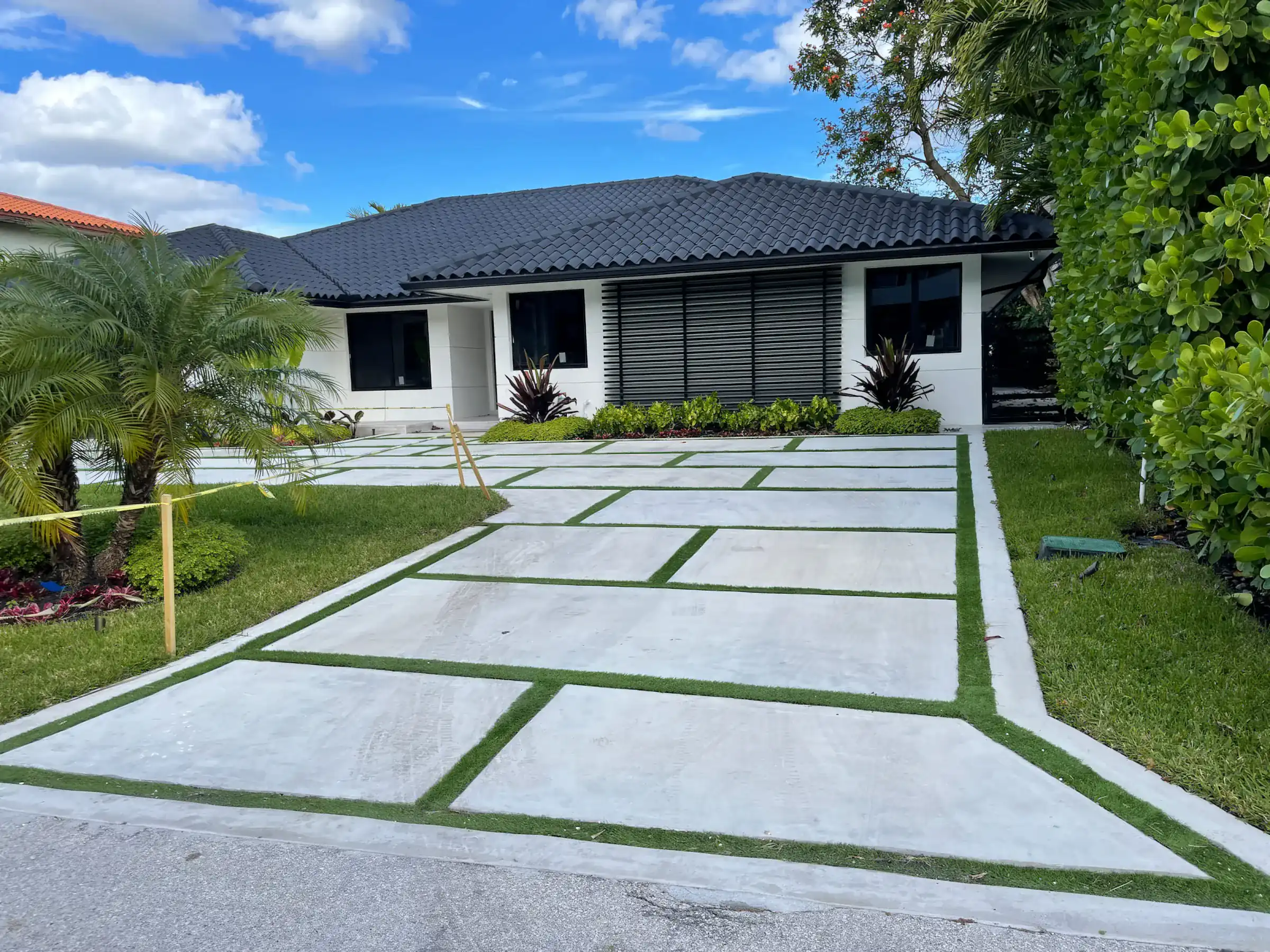
| Concrete with grass or turf strips | Modern slabs separated by green joints | Good | Trimming or turf care in the joints |
If you like the look of stone but prefer a solid slab, read about stamped concrete driveways. If you are still deciding between a slab and pavers, see concrete vs paver driveways.
Is concrete a good choice for Miami's climate?
Yes, when it is built for the climate. Concrete handles heat better than asphalt, which softens in strong sun, and a light-colored slab stays cooler underfoot than dark surfaces. The two things Miami punishes are poor drainage and skipped curing.
- Drainage: heavy summer rain needs somewhere to go. The slab should be sloped away from the house and toward the street or a drain.
- Curing: fresh concrete needs to stay moist while it gains strength. In hot weather, crews protect the pour from drying out too fast.
- Control joints: concrete cracks where it wants to unless joints tell it where to crack. Well-placed joints keep cracks straight and hidden.
Do I need a permit for a concrete driveway in Miami?
In most of Miami-Dade, yes: replacing or adding a driveway is permitted work, and the rules depend on whether you are in the City of Miami, an independent city such as Coral Gables or Pinecrest, or unincorporated Miami-Dade County. Work that touches the swale or sidewalk between your property line and the street usually needs separate approval. A licensed contractor should pull the permit and include it in the quote.
If you live in Coral Gables or Pinecrest, expect extra review. Our guides on Coral Gables permits and Pinecrest projects explain why.
How do I compare two concrete driveway quotes?
Put them side by side and check that both include the same scope. A lower price often means something is missing.
- Is demolition and haul-away included?
- What base material goes under the slab, and is it compacted?
- Is there reinforcement, and what kind?
- Who pulls and pays for the permit?
- What finish, and is sealing included?
- How is drainage handled?
- What does the written warranty cover, and for how long?
For a broader view of what goes into pricing, see our driveway cost guide.
Ready for a real number?
MiamiCrete (Florida certified general contractor, license CGC1529269) builds concrete driveways across Miami. Every price we give is a written quote after we see the site. Request your free written quote or call (305) 790-4850.
Frequently Asked Questions
How much does a concrete driveway cost in Miami?
It depends on the size, demolition, base and drainage work, slab thickness and reinforcement, finish and permit. Ask a licensed contractor for a free written quote after a site visit.
Is a concrete driveway cheaper than pavers?
A plain concrete slab usually costs less to install than pavers, but the gap depends on the site and the finish. Stamped or decorative concrete can close much of the difference. Compare written quotes for both on your own property.
What adds the most to the cost of a concrete driveway?
Usually the work under the surface: removing the old driveway, fixing soft or low ground, and adding drainage. Decorative finishes and permits that require extra review also add cost.
Do I need a permit to replace a concrete driveway in Miami?
In most Miami-Dade cities and in unincorporated Miami-Dade, yes. Work in the swale or sidewalk area usually needs its own approval. Your contractor should pull the permit.
Is concrete good for Miami's heat and rain?
Yes, if the slab is properly cured, jointed and sloped so rainwater drains away from the house. Light-colored concrete stays cooler than dark surfaces.