
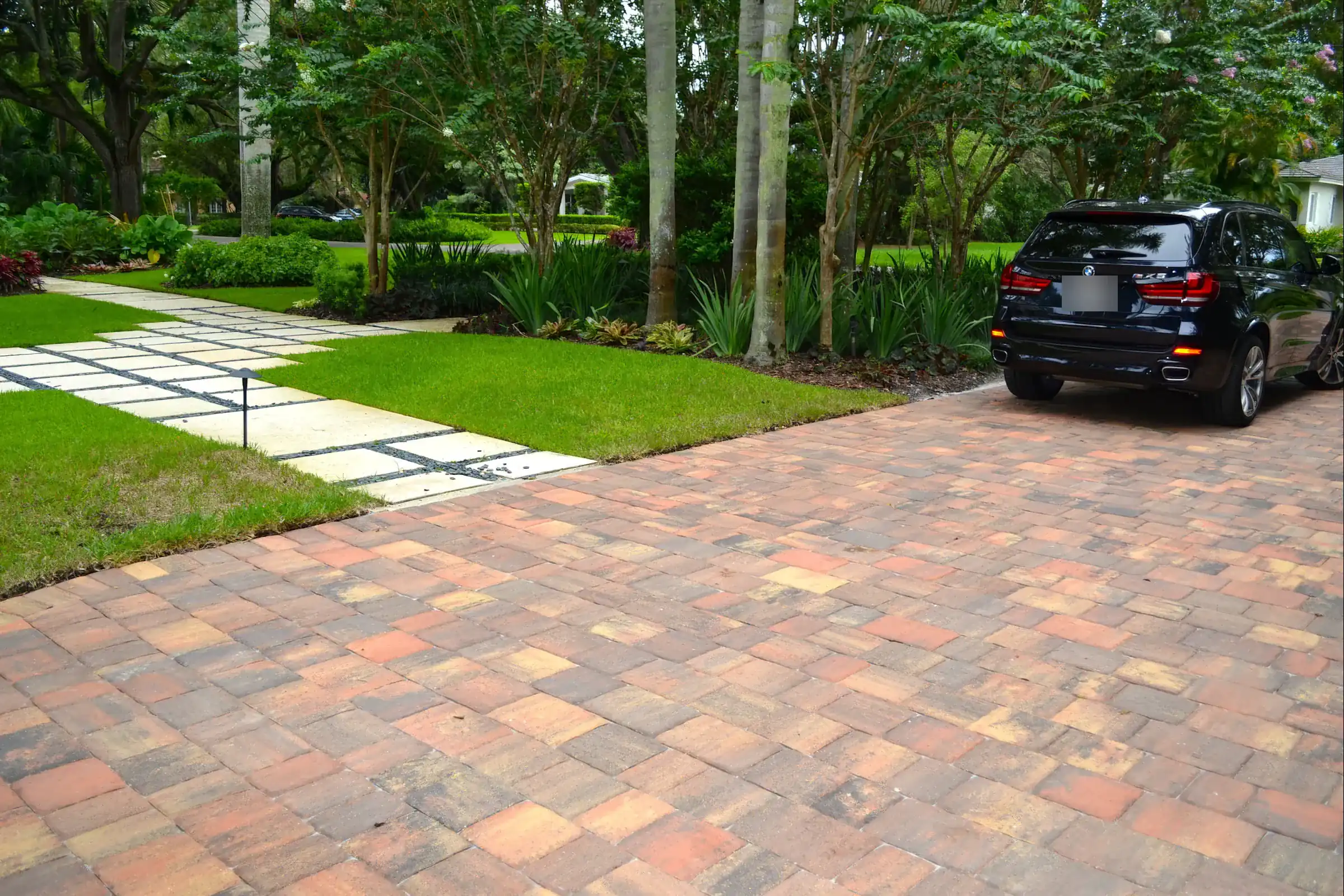
How are stamped concrete and pavers built?
Stamped concrete is a concrete slab that is colored and imprinted while it is still fresh. The Portland Cement Association describes the color coming from pigment mixed into the concrete, from a dry-shake color hardener floated and troweled into the fresh surface, or from both, and says the stamped joints can be filled with plain or colored mortar for contrast. A release agent, powdered or brushed onto the stamping tool, keeps the concrete from sticking and brings out more detail in the texture. The slab is then cut with control joints so that shrinkage cracks follow straight lines, and a sealer protects the color.
Pavers are individual units, usually concrete or clay, laid tight on a thin layer of bedding sand over a compacted aggregate base. Sand fills the joints, and edge restraints hold the field together. The Concrete Masonry & Hardscapes Association, formed when the Interlocking Concrete Pavement Institute merged with the National Concrete Masonry Association, puts the minimum aggregate base for a driveway at 6 to 8 inches, against 4 to 6 inches for a walkway, and ties that thickness to the strength of the soil, the drainage, the climate and the traffic loads.
Stamped concrete vs pavers: how do they compare?
| Stamped concrete | Pavers | |
|---|---|---|
| Structure | One rigid slab with control joints | Many units on sand and a compacted base, flexible |
| Cracking | Can crack; joints guide where | Units rarely crack; the joints let the surface move |
| Repairs | Patches are hard to match in color and pattern | Lift and reset or replace individual units |
| Look | Stone, slate, brick or wood textures in one surface | Real joints and many shapes, colors and patterns |
| Sealing | Needs resealing to protect the color and finish | Optional sealing; joint sand needs topping up |
| Weeds | Very few joints for weeds | Joints can sprout weeds without care |
| Underground access | Cutting needed for pipe or utility work | Units can be lifted and put back |
| Covenant with the permit | Required in City of Miami and unincorporated Miami-Dade | Required in City of Miami and unincorporated Miami-Dade |
Which one cracks less in Miami?
Pavers. A paver driveway is a flexible pavement: when the ground moves a little, the units shift with it instead of breaking. A stamped concrete driveway is rigid, so it will crack sooner or later, like any slab. Well placed control joints make those cracks run where you expect them, and a thicker base and good compaction reduce them, but they do not make a slab crack-proof.
Tree roots are the clearest example. Roots lifting a paver driveway can be fixed by pulling the units, dealing with the root as the tree rules allow and relaying them. Roots lifting a stamped slab usually mean cutting out and repouring a section that will not match perfectly.
What we tell homeowners. When a slab cracks in Miami, the mix is almost never the problem. The base is. On sandy soil with a high water table, a slab poured over ground that was not properly compacted will crack whatever concrete you put on top of it, and no sealer fixes that afterwards. If you choose stamped concrete, spend the argument on the base and the control joints, not on the pattern.
Which one is easier to repair?
Pavers again. The Concrete Masonry & Hardscapes Association guide says repairs to underground utilities and to dips in the base can be reached by removing and later reinstating the same pavers, with no jackhammer and nothing hauled to a landfill. With stamped concrete, a repaired area has new concrete, new color and new texture next to old, weathered work, and the difference usually shows.
That matters when water, sewer or irrigation lines run under the driveway. If a pipe breaks under pavers, the driveway comes back. Under a stamped slab, it gets a patch.
Which one handles Miami heat and rain better?
- Heat: color matters more than material. Light colors in either option stay cooler than dark reds, charcoals or browns.
- Rain: stamped concrete sheds water across its surface, so the slope has to carry the water to the street or a drain. Standard pavers also shed most water off the surface, while permeable paver systems are built to let some water into the base where the soil allows. Either way, drainage is designed, not assumed. See concrete slab driveways with grass joints for another way to break up the hard surface.
- Slipperiness: a glossy sealer on a stamped slab can be slick when wet. Ask for a slip-resistant additive in the sealer, especially on sloped driveways.
Which one needs more maintenance?
They need different maintenance. Stamped concrete needs cleaning and resealing to keep its color and finish; when the sealer wears off, the surface fades and stains more easily. Pavers need cleaning, joint sand topped up after pressure washing, weed control in the joints, and optional sealing. Read why sealing your driveway in Florida matters for what sealers do and do not protect.
Do stamped concrete and pavers need special permits?
Both need a driveway permit. In the City of Miami, pavers, stamped concrete and concrete slabs with spaces between them are "nonstandard materials" that require a covenant making the owner responsible for maintenance. Miami-Dade County asks for a recorded Construction Covenant for driveways other than asphalt or plain concrete, naming brick pavers and stamped concrete as examples. Independent cities run their own review on top of that, each with its own checklist: our guide to getting a permit in Coral Gables walks through one of them.
We file both kinds of permit often enough to know where each one gets stuck. The covenant is the step homeowners do not expect, because it is recorded against the property and it outlives the job. We prepare it with the application rather than after, which is what keeps a driveway permit from sitting.
So which should I choose?
Stamped concrete fits if you: want a continuous surface with few joints, like a stone or slate texture, have stable ground with no large trees near the driveway, and are fine with resealing on a schedule.
Pavers fit if you: have trees or ground that may move, want repairs that disappear, may need access to pipes under the driveway, or want the depth of real joints and patterns.
For plain concrete against pavers, read concrete vs paver driveways. Whichever you pick, driveway installation usually takes between 4 and 10 business days depending on size and material.
Want both options quoted?
MiamiCrete (license CGC1529269) installs stamped concrete and driveway pavers in Miami, so we can price both for your driveway and show you samples on the same visit. See all our driveway options, then request a free written quote or call (305) 790-4850.
Sources, checked 17 November 2026: Portland Cement Association, Finishing Concrete Slabs with Color and Texture (PA124); Concrete Masonry & Hardscapes Association (formerly ICPI), Application Guide for Interlocking Concrete Pavements; CMHA, ICPI + NCMA = CMHA; City of Miami, Standalone Driveway Permit Applicant Checklist (2026); Miami-Dade County, Other Permits: Driveways.
Frequently Asked Questions
Is stamped concrete cheaper than pavers?
It depends on the pattern, colors, base work and size of your driveway. Ask for written quotes for both on the same site so you compare the same scope.
Does stamped concrete crack?
Yes, like any concrete slab it can crack. Control joints guide where the cracks form, and a well compacted base reduces them.
Are pavers better than stamped concrete around trees?
Usually. Pavers flex with small ground movement and can be lifted and relaid if roots push them up, while a stamped slab has to be cut and repoured.
How often does stamped concrete need sealing?
When the sealer starts to wear and the color looks dull or absorbs water. Sun, traffic and the sealer product set the pace, so follow the sealer maker's guidance.
Do I need a covenant for a stamped concrete driveway?
In the City of Miami and in unincorporated Miami-Dade, yes. Both treat stamped concrete and pavers as materials that need an owner maintenance covenant with the permit.