
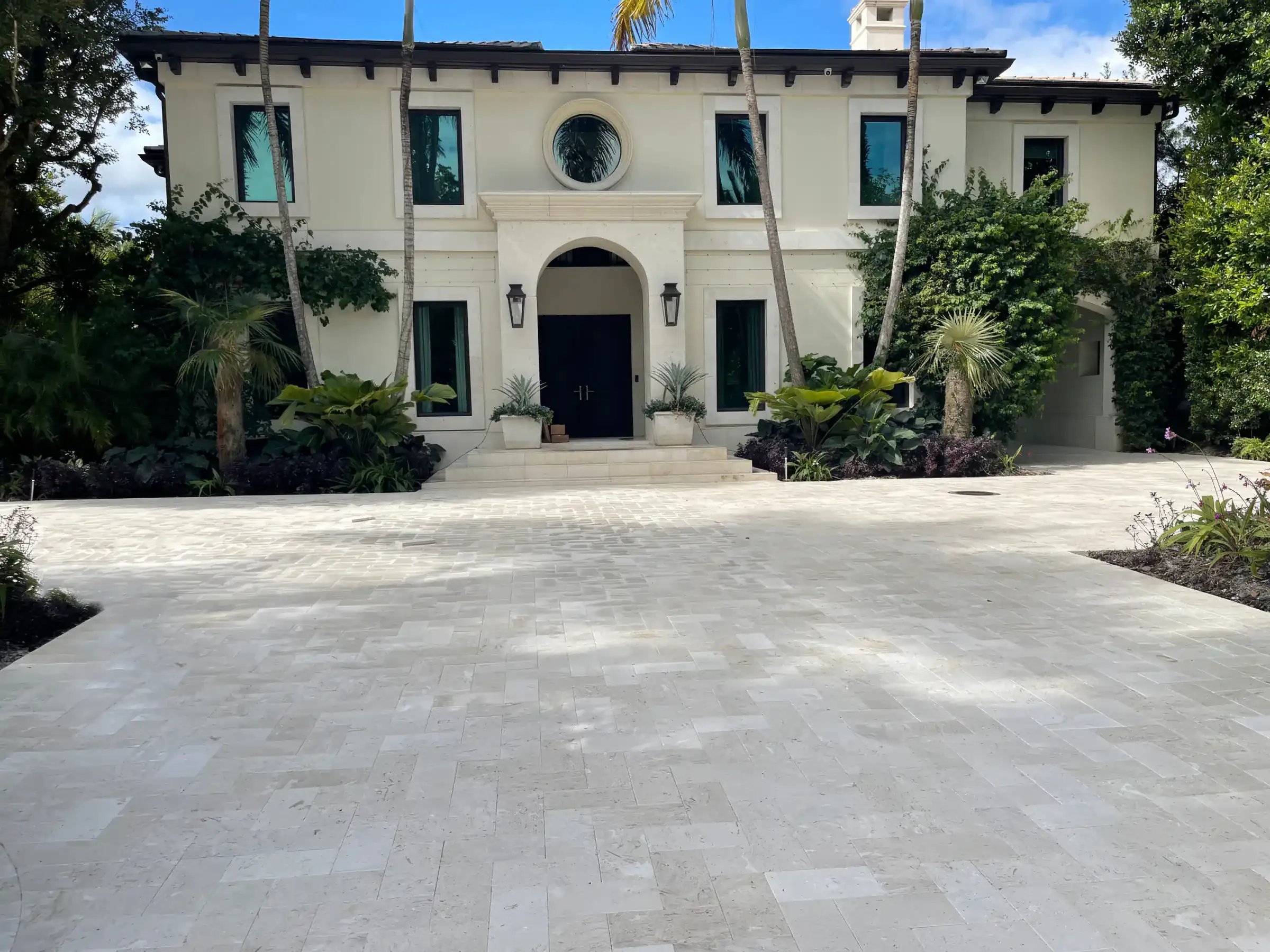
Why is travertine popular in Miami?
- Cooler underfoot: light colors and natural porosity keep it cooler than many surfaces, which matters around pools.
- Grip when wet: tumbled and brushed finishes provide traction.
- Look: natural variation in color and texture suits Mediterranean, Spanish and modern homes alike.
- Durability: a properly installed travertine surface lasts for many years with care.
What colors and finishes does travertine come in?
Common colors: ivory and cream (light, cool, classic), gold and beige (warm tones), walnut and noce (darker browns), silver and gray (cooler, modern tones). Blends mix several tones.
| Finish | Surface | Grip when wet | Best use |
|---|---|---|---|
| Tumbled | Soft, rounded edges, textured, aged look | Very good | Pool decks, patios, walkways, driveways |
| Brushed | Lightly textured, smoother than tumbled | Good | Patios and decks |
| Honed | Smooth, matte | Lower; can be slippery when wet | Covered areas, indoors |
| Polished | Glossy | Poor when wet | Indoors only; not for pools or driveways |
| Filled vs unfilled | Natural holes filled with resin or cement, or left open | Unfilled has more texture | Ask which suits your use |
Can travertine be used for a driveway?
Yes, with the right product and installation. Driveway travertine must be thick enough for vehicle loads, and the base must be built for cars, not just foot traffic. Ask your installer to confirm the paver thickness and the base design for a driveway. See our travertine driveway page and a real example in the photo above.
How is travertine installed?
- Remove the old surface and soft soil.
- Grade for drainage away from the house and pool.
- Build and compact the aggregate base.
- Install edge restraints, or set the edges on a concrete border.
- Lay the pavers on bedding sand (or mortar-set over a slab, depending on the design).
- Cut edges and curves precisely.
- Fill joints and compact.
- Seal, if chosen.
Natural stone varies piece to piece, so pavers are often pulled from several crates and blended for an even look. Precise cutting matters around pools, steps and curves.
How do I care for travertine pavers?
- Sweep regularly so sand and grit do not scratch the surface.
- Clean with a pH-neutral cleaner. Avoid acids such as vinegar, which etch limestone.
- Wipe spills quickly, especially wine, oil and fruit. Fallen mangoes and other fruit can stain.
- Rinse pool splash-out and follow the sealer's care instructions.
- Reseal when water no longer beads on the surface.
Should travertine be sealed in Miami?
Sealing is recommended for most outdoor travertine in Miami because the stone is porous. A penetrating sealer helps resist stains and salt without making the surface slippery. Avoid high-gloss sealers on pool decks. Read why sealing matters in Florida.
Travertine or concrete pavers?
| Travertine | Concrete pavers | |
|---|---|---|
| Material | Natural stone | Manufactured |
| Heat | Stays comparatively cool | Depends on color |
| Look | Natural variation, high-end | Uniform, many styles |
| Care | pH-neutral cleaning, sealing | Joint sand, optional sealing |
| Price | Depends on grade, thickness and site; ask for a written quote | Depends on product and site |
For pool decks specifically, see which pavers are most slip-resistant around pools.
What should I ask a travertine installer?
- Have you installed travertine driveways and pool decks? Can I see them?
- What thickness and grade do you recommend for my use?
- How will you build the base and handle drainage?
- Will you blend pavers from several crates?
- Which sealer do you use, and why?
- What does your written warranty cover?
Ready for travertine?
MiamiCrete (license CGC1529269) installs travertine in Miami neighborhoods such as Coral Gables and Coconut Grove. Request a free written quote or call (305) 790-4850.
Frequently Asked Questions
Are travertine pavers good for Miami?
Yes. They stay comparatively cool, grip well when wet in tumbled or brushed finishes, and suit the local architecture. They should be sealed and cleaned with pH-neutral products.
Can you use travertine for a driveway?
Yes, with pavers thick enough for vehicles on a base designed for cars.
Is travertine slippery around a pool?
Tumbled and brushed travertine has good grip when wet. Polished and honed finishes are slippery and are not recommended for pool decks.
Do travertine pavers need to be sealed?
Sealing is recommended outdoors in Miami because travertine is porous. Use a penetrating, non-gloss sealer.
How do you clean travertine pavers?
Sweep often and use a pH-neutral stone cleaner. Avoid vinegar and other acids, which etch the stone.